
The conversation
Ask anything, in any language.
A stock, a headline, a fund or a coin. Quick questions come back in seconds, and a full analysis takes about two minutes.
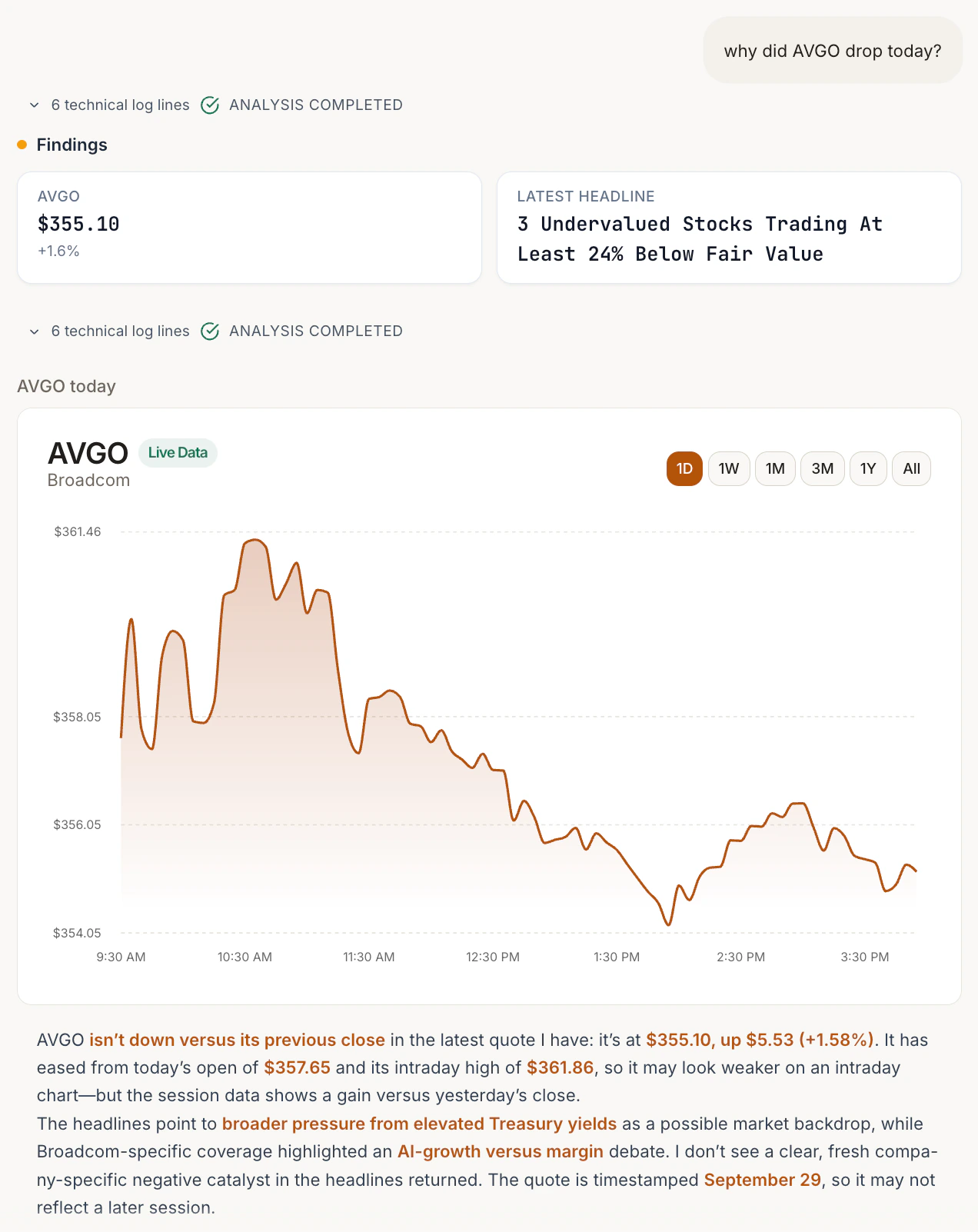
Free during early access
Your personal analyst. Powerful enough to build the model and the report in minutes. Careful enough to source every number and flag where the Street disagrees.
Free during early access

Name a company or ask a question. VYNN pulls the financials, the prices and the news, builds the model, and answers in about two minutes.
Or read how VYNN answered
Microsoft
“Is Microsoft a good investment at today's price?”
At $509.22, Microsoft needs about 11% revenue growth a year for ten years.
Analysts' forecasts come to about 13%.
Buy, low confidence
Fair value $597.02. The Street's $577.26 target points the same way, so there is no gap to flag.
One question, start to finish
Costco, asked in the app on 2 Oct 2026. Every line below is copied from that run's record and its workbook, which you can open.
I'm thinking about buying Costco. Is it a good investment at today's price?
done2 min 33 s
The conversation
A stock, a headline, a fund or a coin. Quick questions come back in seconds, and a full analysis takes about two minutes.
The work
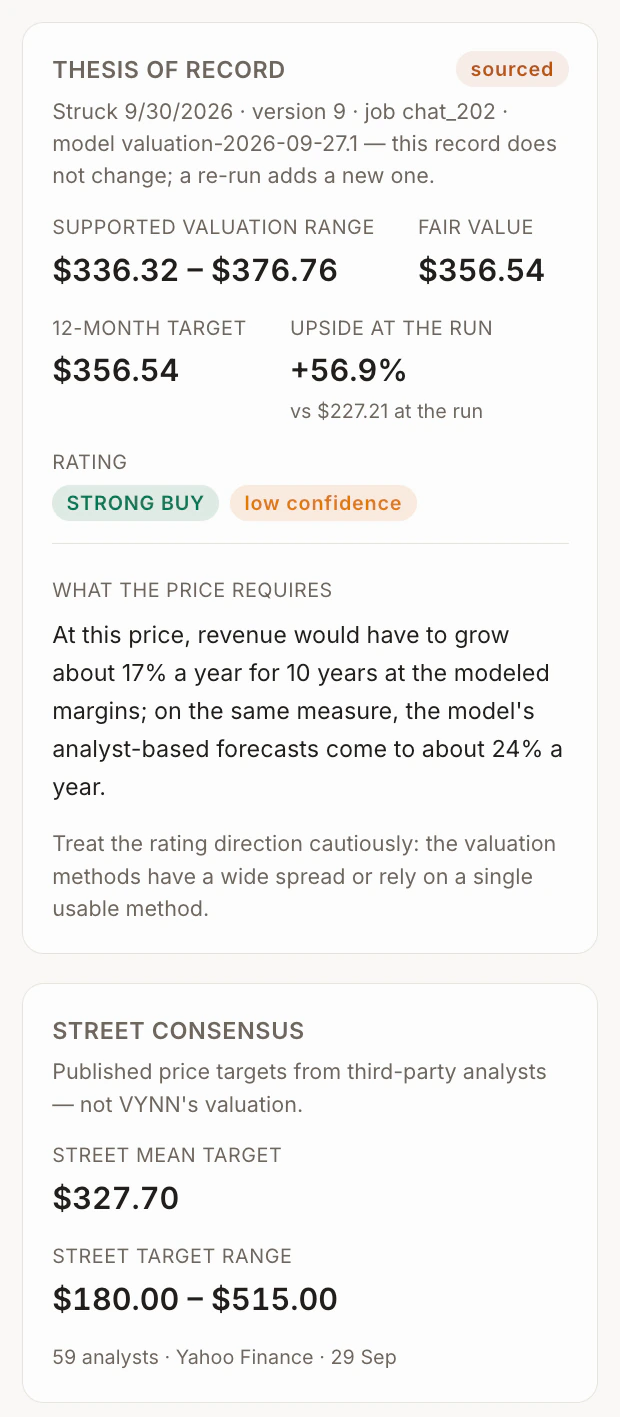
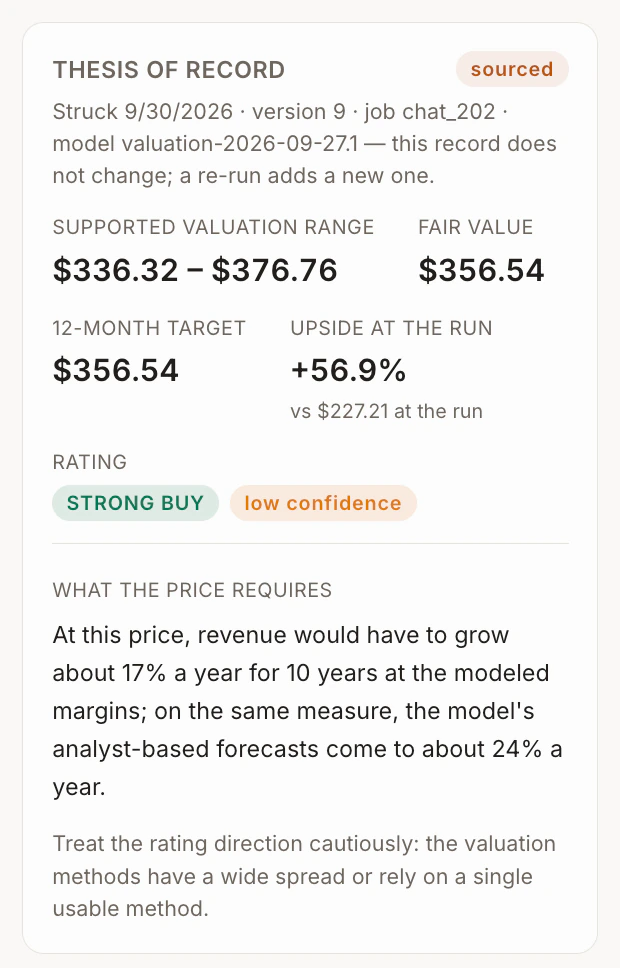
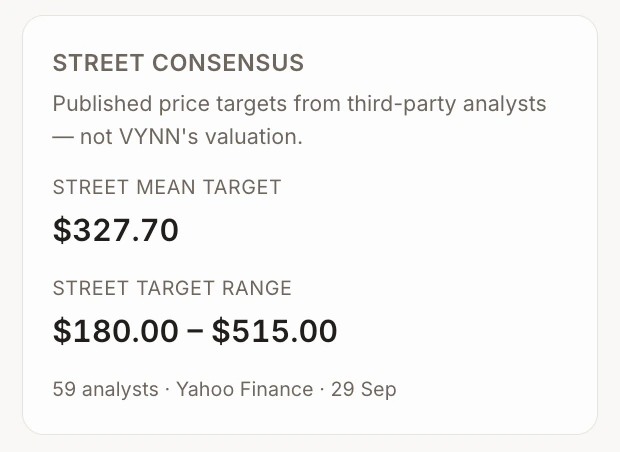
The range, the fair value and the rating are dated and versioned. The Street's targets sit in their own card, never blended in.
The files
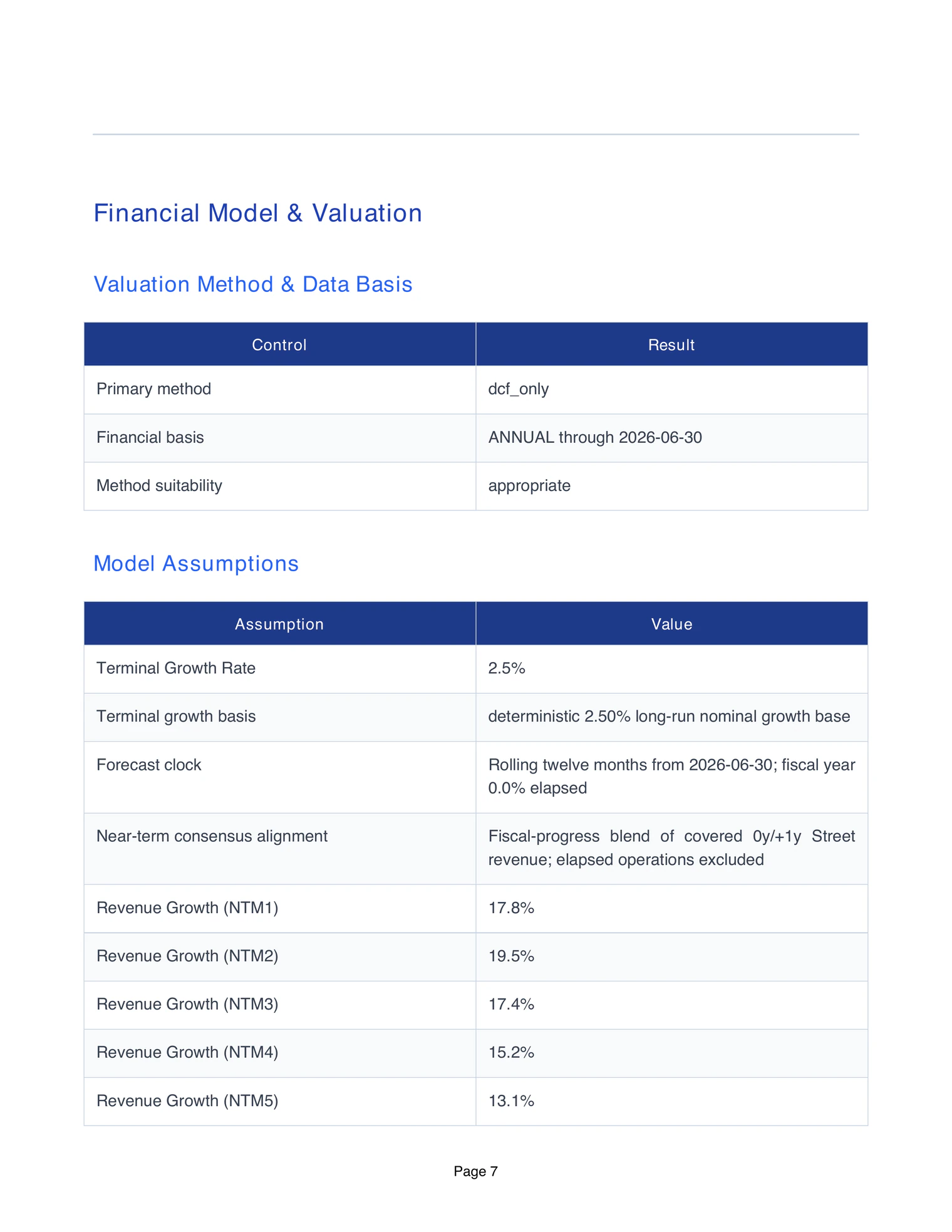
A report of more than 30 pages and a 10-tab Excel model with live formulas, so you can check any step or change an assumption yourself.
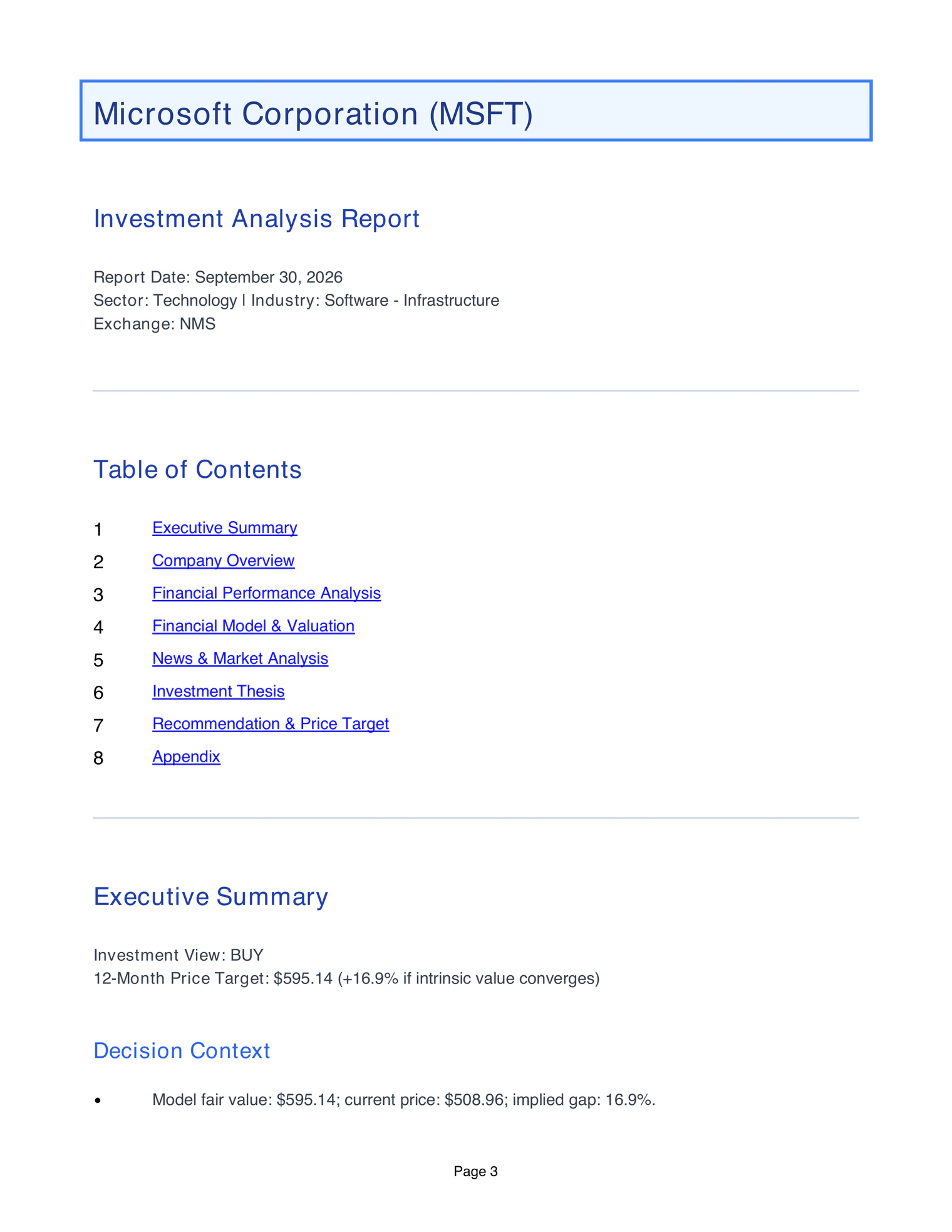
Microsoft · Run of 30 Sep 2026
$595.14fair value, against $508.96
Buy, low confidence
Read the full research recordAlso on the record: NVIDIA · Alphabet · Visa · Apple
Open Microsoft’s report (PDF) and model (Excel).
Your companies
Every company you follow, with its latest thesis, how far the price has moved since, and which ones need you.
Guardrails
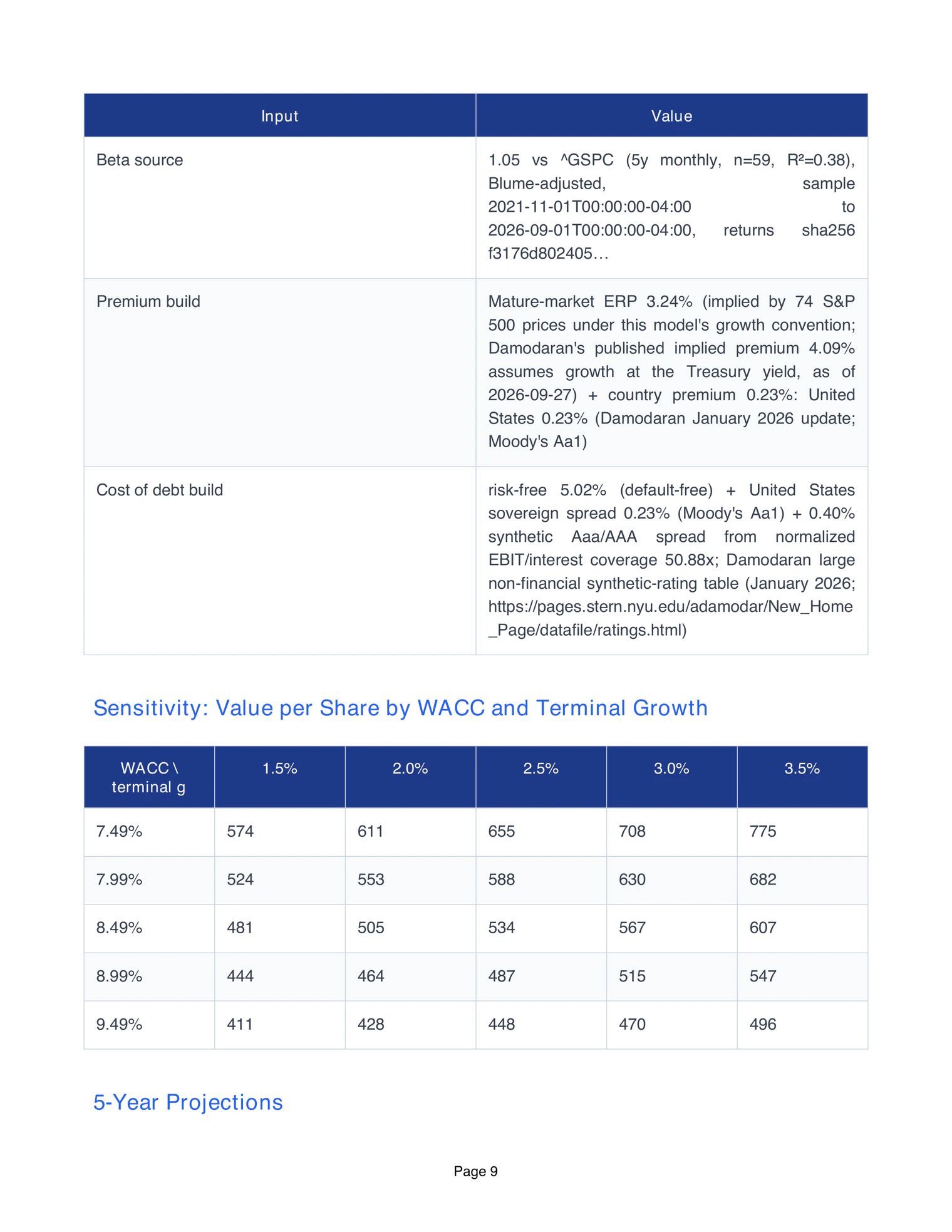
The gap is everything around the formulas: where each input comes from, whether the arithmetic holds, and what happens when the evidence runs thin. Here is Microsoft's cost of capital, exactly as VYNN built it on 30 Sep 2026.
A. WACC calculation
PublishableThe deterministic valuation publication checks passed.
Open this workbookTen tabs, live formulas, every input with its source.Read Microsoft’s full record
In valuation there is no certain answer, only better evidence. VYNN shows its own value, the analysts' value and the arithmetic behind both. When the two are far apart it says so plainly, and the call is yours.
Microsoft · 29 Sep 2026
Buy
Published, low confidence
The model and the Street’s price targets point the same way.
Costco · 2 Oct 2026
Strong Sell
Flagged: a large gap to the Street
VYNN’s value sits 52% below the price and the analysts’ target 15% above it. VYNN still makes the call, marks it low confidence and shows both, with the arithmetic.
Not every business is a cash-flow story. For commodity producers, REITs, insurers, funds and crypto, VYNN says so in one sentence and answers with the evidence that fits.
The record
Run it again later and the new version sits beside the old one, so you can see what moved and why.
10 Sep 2026 Microsoft · v1
Price at the run $490.21 · cost of capital 9.20%
Kept exactly as it was.
29 Sep 2026 Microsoft · v2
Price at the run $509.22 · cost of capital 8.47%
Added beside it by a new run on the updated engine.
In development: real-time alerts. VYNN will watch what you own and tell you the moment news, results or a price move would change your thesis, instead of waiting for you to ask.
Funds, crypto, prediction markets and your whole portfolio, each in a workspace built for it. Private equity is on the roadmap.
Holdings, fees, exposure, performance and risk for ETFs and index funds.
Something else? Write to the founder
Ask about a company, a headline, a fund, a coin, an option or your portfolio, in your own words and in any language. For a company, VYNN can run a full analysis: a report, a workbook with live formulas, and a dated record in your workspace.
VYNN flags the gap and shows its work: its own value, the Street's beside it, the arithmetic, and one sentence on why they differ. In valuation there is no certain answer, so the call is yours. And when the headlines don't explain a move, it tells you what moved instead of inventing a reason.
Real-time alerts are in development: VYNN will watch what you own and tell you when news, results or a price move would change your thesis. Analysis for private equity is planned, beyond public stocks and funds.
Nothing during early access. You can run up to 20 analyses an hour. Sign in with Google or GitHub.
No. VYNN is a research tool. It shows you the numbers, the reasoning and the sources, and you make the decision.
Ask about the company you're thinking of buying, or the one you already own.
Free during early access · Sign in with Google or GitHub